Ministers back binding European forest agreement
By Mark Kinver, Environment reporter, BBC News, Oslo
Ministers have agreed to back plans to introduce a legally binding agreement to protect Europe's forests. Delegates also agreed to adopt resolutions that would help shape forest policy over the next decade.
On Tuesday, a report concluded that sustainable forestry management was essential if the EU was to reach its emission goals.
The ministerial agreement was signed at the sixth Forest Europe conference in Oslo, Norway.
The Norwegian host chairman, Rural Affairs Minister Lars Peder Brekk, said the signing of two ministerial declarations was a fitting end to Norway's four-year leadership of the Forest Europe process.
As well as signing the declaration to begin negotiations to establish a legally binding agreement (LBA), delegates also agreed to set a number of targets to be achieved by 2020.
These included all European countries implementing a national forest programme, which needed to contain climate adaptation and mitigation strategies.
Ministers also agreed to cut the rate of biodiversity loss within forest habitats by half, and take steps to eliminate illegal logging.
Poland's minister, Janusz Zaleski, said that the LBA declaration presented a "new chapter" in the management of Europe's forests.
However, he added that nations needed to ensure that any agreement would need the legal weight required to deliver progress on the ground.
"In order to effectively protect Europe's forests, we must not follow the example of other international processes, such as climate negotiations.
"Therefore it is important to assess the progress of improving the state of Europe's forests.
Mr Zaleski told reporters that Poland intended to use its six-month presidency of the EU, which begins in July, to help promote the process.
Binding concerns
But there was not universal support for adopting a legally binding agreement.
Sweden's Rural Affairs Minister Eskil Erlandsson told the conference that while he supported the concept of sustainable forest managment, he favoured a voluntary approach rather than an LBA.
"I do not believe in common legislation for forests across the pan-European region. Put simply, one size does not fit all," he said.
"We need to recognise the different geo-climatic and socio-economic conditions.
"Therefore, my conclusion is that the voluntary track is the best way of supporting the development and implementation of sustainable forest management."
However, he said he signed the declaration in order for negotiations to begin.
Responding to the minister's concerns, Mr Brekk said: "The most important thing is that all countries agree that we are start up this process.
"They all see that it is necesssary to have an agreement to secure a sustainable forest policy in the future.
"Of course, we then have to go through the negotiations in order to find out what each country thinks during this process."
As the conference closed and Spain took over the Forest Europe leadership, Mr Brekk was asked to comment on concerns that had been raised about Norway's high-profile $1bn climate deal with Indonesia, which included a two-year logging moratorium.
Media reports said environmental groups were unhappy that the fine detail of the deal had been influenced by logging industry lobbyists.
Mr Brekk explained that it fell outside his ministerial responsibilities, but observed:
"The partnership is still very much alive - of course it is," he told BBC News.
"For Norway - all forests are important, whether it be European forests or tropical forests."
Thursday, 16 June 2011

Mongabay - the trend in deforestation
Mongabay is an excellent resource for all things forest - here' s a video from last November explaining the current trend in deforestation - really interesting stuff.
We need to halt deforestation within a decade...
WWF - we need to halt deforestation within a decade...
As the latest United Nations climate change talks reach their final stages, CARE International, Greenpeace and WWF are calling on the world’s governments to show leadership and unite on efforts to halt forest loss by 2020.

The details of a global mechanism to reduce emissions from deforestation and forest degradation in developing countries (REDD+) were under negotiation at the climate talks this week.
Yet, REDD+ alone will not save the world’s tropical forests and stop runaway climate change unless further urgent action is taken to reduce emissions in all countries, said CARE, Greenpeace and WWF. The organizations are calling on governments to commit to ambitious goals that set the scale and urgency for halting forest destruction. In addition, demand for biofuels, animal feed and beef should not lead to more forests being converted to agricultural land, said the groups.
“We are spending precious time designing a complex system of rules for REDD+. These are necessary to protect the rights and livelihoods of the millions of poor men and women who depend on forests,” commented Raja Jarrah, CARE’s Senior Advisor on REDD+.
“But this is only part of the story. With no ambitious commitment to cut global emissions, it is like treating a patient’s lung disease without asking him to stop smoking.”
While considerable progress has been made on working out the details of REDD+ in these UN climate talks, negotiators must not shy away from making the big commitments that will ensure REDD+ is successful in halting forest loss and tackling climate change, the groups said. This will also put the world on the path to a future built on low carbon economies.
“In Bonn, developed countries including the United States have been calling on developing countries to monitor, report, and verify (MRV) their emissions. But what we actually need is for all countries to be transparent about how their policies, including for public and private finance, are supporting the drivers of deforestation,” said Roman Czebiniak, Senior Policy Advisor for Greenpeace.
Industrialized countries also have a critical role to play in providing adequate, predictable and sustainable financing for REDD+, said the organizations. The needed finance to support REDD+ actions should be addressed at the UN climate change talks in Durban South Africa at the end of this year.
“The world must step-up with the money needed to support forest countries’ efforts to end forest loss,” said Gerald Steindlegger, WWF’s Policy Director on Forests and Climate.
“Investing in maintaining our forests is essential to people and nature.”
As the latest United Nations climate change talks reach their final stages, CARE International, Greenpeace and WWF are calling on the world’s governments to show leadership and unite on efforts to halt forest loss by 2020.

The details of a global mechanism to reduce emissions from deforestation and forest degradation in developing countries (REDD+) were under negotiation at the climate talks this week.
Yet, REDD+ alone will not save the world’s tropical forests and stop runaway climate change unless further urgent action is taken to reduce emissions in all countries, said CARE, Greenpeace and WWF. The organizations are calling on governments to commit to ambitious goals that set the scale and urgency for halting forest destruction. In addition, demand for biofuels, animal feed and beef should not lead to more forests being converted to agricultural land, said the groups.
“We are spending precious time designing a complex system of rules for REDD+. These are necessary to protect the rights and livelihoods of the millions of poor men and women who depend on forests,” commented Raja Jarrah, CARE’s Senior Advisor on REDD+.
“But this is only part of the story. With no ambitious commitment to cut global emissions, it is like treating a patient’s lung disease without asking him to stop smoking.”
While considerable progress has been made on working out the details of REDD+ in these UN climate talks, negotiators must not shy away from making the big commitments that will ensure REDD+ is successful in halting forest loss and tackling climate change, the groups said. This will also put the world on the path to a future built on low carbon economies.
“In Bonn, developed countries including the United States have been calling on developing countries to monitor, report, and verify (MRV) their emissions. But what we actually need is for all countries to be transparent about how their policies, including for public and private finance, are supporting the drivers of deforestation,” said Roman Czebiniak, Senior Policy Advisor for Greenpeace.
Industrialized countries also have a critical role to play in providing adequate, predictable and sustainable financing for REDD+, said the organizations. The needed finance to support REDD+ actions should be addressed at the UN climate change talks in Durban South Africa at the end of this year.
“The world must step-up with the money needed to support forest countries’ efforts to end forest loss,” said Gerald Steindlegger, WWF’s Policy Director on Forests and Climate.
“Investing in maintaining our forests is essential to people and nature.”
Wednesday, 15 June 2011
Fifth Activist killed in Brazil's Amazon over deforestation...
Peasant activist shot dead in Brazil's Amazon region
Killing of Obede Loyla Souza is fifth murder in a month in amid conflict over land and logging
Associated Press and taken from guardian.co.uk,
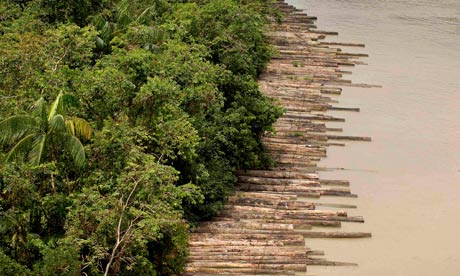
Confiscated illegally logged timber floats down the Guam river delta in Pará, Brazil. Photograph: Reuters/Brazil
A landless peasant activist has been killed by a gunshot to his head outside his home in Brazil, the fifth murder in a month amid a conflict over land and logging in the country's Amazon region.
Costa travelled to the remote settlement to interview witnesses and support the victim's wife and children, who are also afraid for their lives.
Police from the nearby town of Tucuruí confirmed the death and said the investigation was ongoing. Members of a police force created by the federal government this month to control violence in the region took the body to the state capital, Belém, for an autopsy. It was returned on Tuesday for burial. They could not be immediately reached for comment.
The state law enforcement agency in charge of land conflicts, the Agrarian Conflict Delegation, was not participating in the investigation, a spokesman said, declining to give his name because of department policy.
The Catholic Land Pastoral monitors the threats made by loggers, ranchers and farmers to silence protest over illegal extraction of wood and the violation of land rights in the environmentally sensitive region. More than 1,150 rural activists have been killed in conflicts over land and logging in the past two decades, and the group has a list of 125 activists who know their lives are in danger.
The 31-year-old peasant was part of a landless settlement that occupied unused farmland in 2008, setting up a camp whose name, Esperanca, means Hope. He had been farming a small plot there alongside his wife and three children and waiting for the government land redistribution programme to recognise their claim.
Costa said that in January, Souza got into an argument with a representative of loggers who are illegally harvesting wood in the region, targeting the region's Brazil nut trees, which are protected under law. He knew he was in danger from then on, said Costa.
"There is in this region a really dangerous group of loggers," said Costa. "He had a fight with one of them over the cutting of these trees, and he was a marked man from then on."
Witnesses who did not want to give their names told Costa they saw four men in a pickup truck asking for Souza. The witnesses are also afraid for their lives, Costa said.
Within the last month, four activists have been shot to death, along with a witness to two of the murders.
The increase in execution-style killings led to an outcry in Brazil's government, which created a working group to monitor the region, and reinforced paltry local police forces with officers from the federal police, highway patrol and national guard.
Help must come quickly, because there are others whose lives are in danger, said the president of another landless camp, Francisco Evaristo da Conceicao.
He was friends with the victim, and part of the same movement to seize unused farmland for peasants without land. He heads the Barrageira settlement – a more established community of 107 families.
Like the victim, he had had run-ins with loggers, he said, and had been threatened by men he thought were part of the same group who killed Souza.
"We have a lot of problems with the loggers – they invade land, and clear out forest," he said. "We fight them, but it's complicated. Men have stopped at my house looking for me. Now I have to be more careful."
Elephants face Extinction
Elephants face same extinction fate as woolly mammoth

Forest elephants are smaller than their savannah-dwelling cousins and have straighter tusks
The fate of the forest elephant rests in our hands. But will it go the way of the woolly mammoth, as it is hunted for ivory and its habitat is destroyed?
Have you ever wondered why hawthorn trees have such vicious thorns? Like many spiny plants, this is a defence they have evolved to avoid being eaten - by giant herbivores, including elephants.
Throughout the UK there are similar evolutionary clues nodding to the not so long-extinct plant-eating giants that once roamed here.Up until about 15,000 years ago modern elephants' ancestors - mammoths, mastodons, gomphotheres and a host of other elephant-like mammals - were spread throughout the globe.
Mammoths were "just a species of elephant," says Professor Adrian Lister of the UK's Natural History Museum.
"And until the end of the Pleistocene, there were millions of them throughout the globe, including in northern Europe and North America."
But, as the climate shifted, their open grassland habitat was invaded, either by forests or tundra.
"That loss of habitat squeezed the species down into small fragmentary populations," says Professor Lister. "And human hunting may have helped mammoths on their way to extinction once they were in this perilous state."Now, it seems, we could be repeating history.
The remaining three elephant species have been squeezed down into three areas - Asia, the African savannah and the forests of central Africa. And as well as the endangered Asian elephant, the relatively diminutive African forest elephant - only recently shown to be a distinct species - is now in crisis.

Forest elephants' habitat protected them, to some extent, from the "ivory holocaust" of colonial times
Forest elephants in Africa, to some extent, escaped the "ivory holocaust" during colonial times, and the widespread slaughter of their savannah-dwelling cousins for their ivory in the 1970s and 1980s. This was largely because they were hidden away in their obscure forest habitat in the vast Congo Basin.Stephen Blake is an elephant expert from the Max Planck Institute for Ornithology in Radolfzell, Germany, who worked on forest elephants for more than a decade for the US-based Wildlife Conservation Society (WCS). He says that this habitat is now being chopped up.
"Forest elephants need vast uninterrupted areas of wilderness to range through.
"But as logging and resource extraction become more important in the region, the animals are squeezed into smaller pockets of forest where they become easily accessible to poachers.
"There are no good estimates of how many forest elephants remain - probably some tens of thousands, but they are being poached at an alarming rate."

Road-building is fragmenting the forest elephants' habitat
urprisingly, the biggest problem is not the destruction of forest habitat for logging - although this is damaging. It is actually the construction of roads that is doing the most damage to the species.
Kate Evans, a US conservationist and founder of the charity Elephants for Africa says: "The roads go straight through the heart of the forest, so they also provide easy access for poachers."
And where these roads are not protected by law enforcement, forest elephants are petrified of them.
Dr Blake explains: "If you put a 20 mile ring of death around your house, the chances are you won't want to go more than 15 miles from home.
"And if that ring [closes in], you're going to feel besieged.
"You won't be able to go to the places you need to, you won't be able to see your friends, you will become imprisoned, and most likely the food will start to run out. It's just like that with forest elephants."
The illegal ivory trade - fuelled by civil unrest and organised crime in some central African countries - supports the poaching.Kate Evans says that forest elephants' relatively straight and dense tusks are highly attractive to carvers and poachers.
"Most of the market is in Asia," she says. With a growing middle class that have access to cash, we have seen an explosion in the demand for ivory there."
According to Traffic International, the wildlife trade monitoring network, organised criminal gangs in Asia are shipping large quantities illegal ivory from Africa.
While in central Africa, ivory products are openly sold in village shops.

The researcher and his colleagues spent several months camping in the dense forests tracking the elephants. He has found that, during their lumbering treks, forest elephants can vacuum up hundreds of pieces of fruit from under a single tree.
They then deposit the seeds they have eaten with a generous helping of fertiliser - in the guise of elephant dung - throughout the forest. Another side effect of their fruit-rich diet is that they probably defecate around 17 times per day.
"Almost every pile of elephant dung contains viable seeds from up to 16 different plant species and thousands of individual seeds," says Dr Blake.
"Tropical forests are so diverse that a seed that lands near its parent plant has a suite of seed predators and pathogens waiting to nab it," he explains.
"So if you're a seed and you land under your parent, the probability of you surviving is almost zero."
Forest elephants, however, can take seeds several kilometres from their parent plant.

"It's like the parable from the bible - some seeds will land on stony ground, some on poor soil, but some will land on good soil...
And a myriad of other species depend on the structure of the forest that the elephants create.
"Insects, mosses, lichens, invertebrates, other vertebrates; a whole gamut of animal, plant and fungal species are specific to certain trees or plants," explains Dr Blake.
"If we lose elephants, we're going to lose those trees; forest biodiversity as a whole is going to diminish."
Professor Lister says that forest elephants are suffering from the same "double whammy" that claimed the woolly mammoths - habitat loss and hunting.
"Today both of those sides of the pinch are caused by humans," he says.

Old piles of elephant dung become fertile grounds for seed germination in the forests
"I think the extinction of the mammoth is a salutary lesson that applies to modern extinctions." Dr Blake says that time has already run out for the forest elephant.
It could be too late for the lessons we could learn from the mammoth and the mastodon to make a positive difference.
As resource extraction from central Africa becomes more important, more roads and bigger roads will cut through the forests of the Congo basin.
Without effective wildlife management, the elephants will eventually have nowhere left to hide, Dr Blake says.
"We have seen some exciting initiatives like the development of national parks and landscape scale management programmes developed over the last 20 years, but the resources needed to manage these areas properly are pitiful compared to those available for resource extraction."
"I think we've basically blown it."
Subscribe to:
Posts (Atom)